
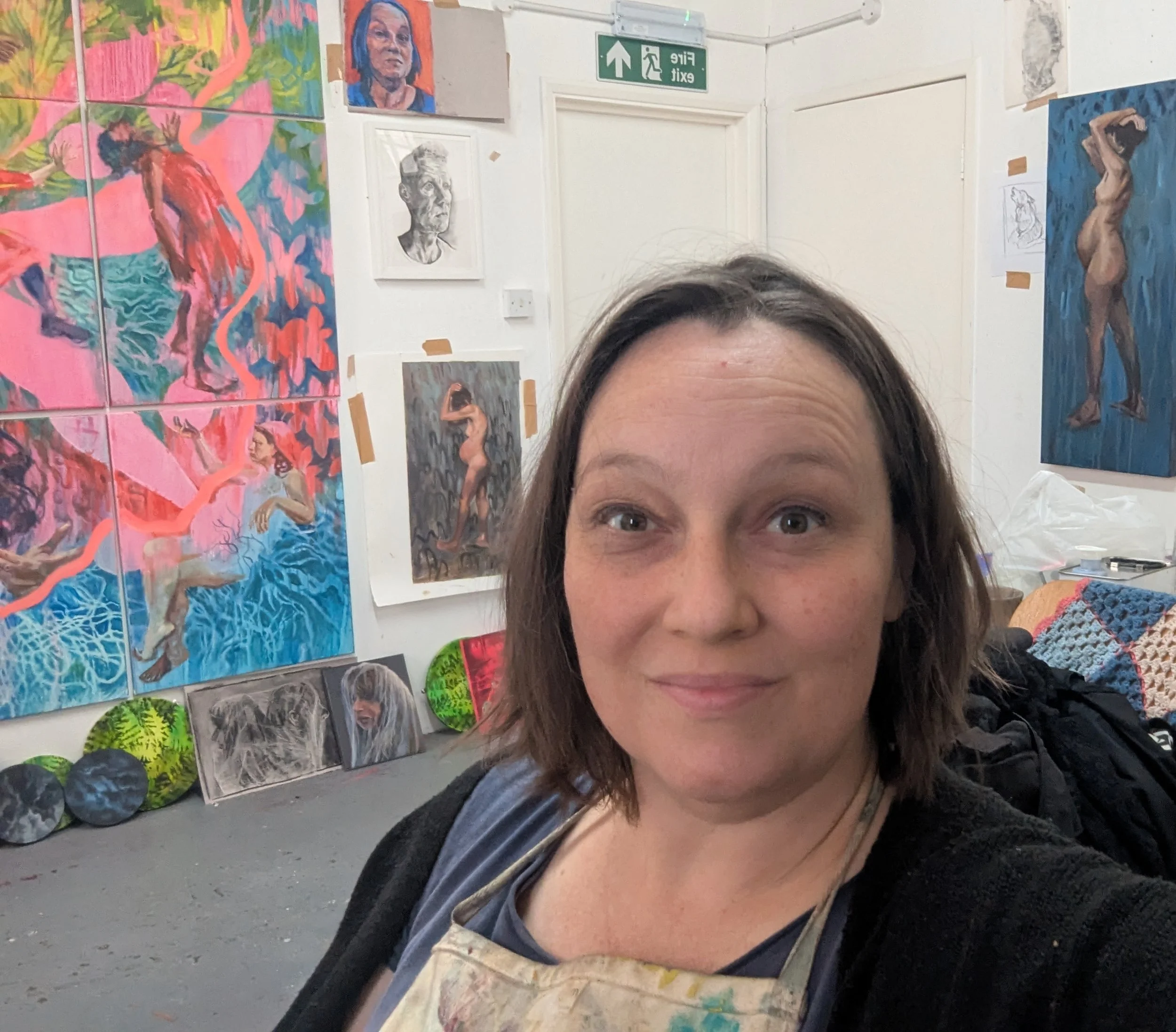
Kristin is a painter based in Reading whose work explores motherhood, isolation, inequality, and women’s experiences through paint. She holds an MA in Fine Art from the University of Reading, where she won the Owen Ridley Prize. Her work has been exhibited across the UK, including the Society of Women Artists, ING Discerning Eye, and Shape Open 2025.
https://www.kristinrawcliffe.co.uk
@kristinrawcliffe
1 - Could you explain your practice?
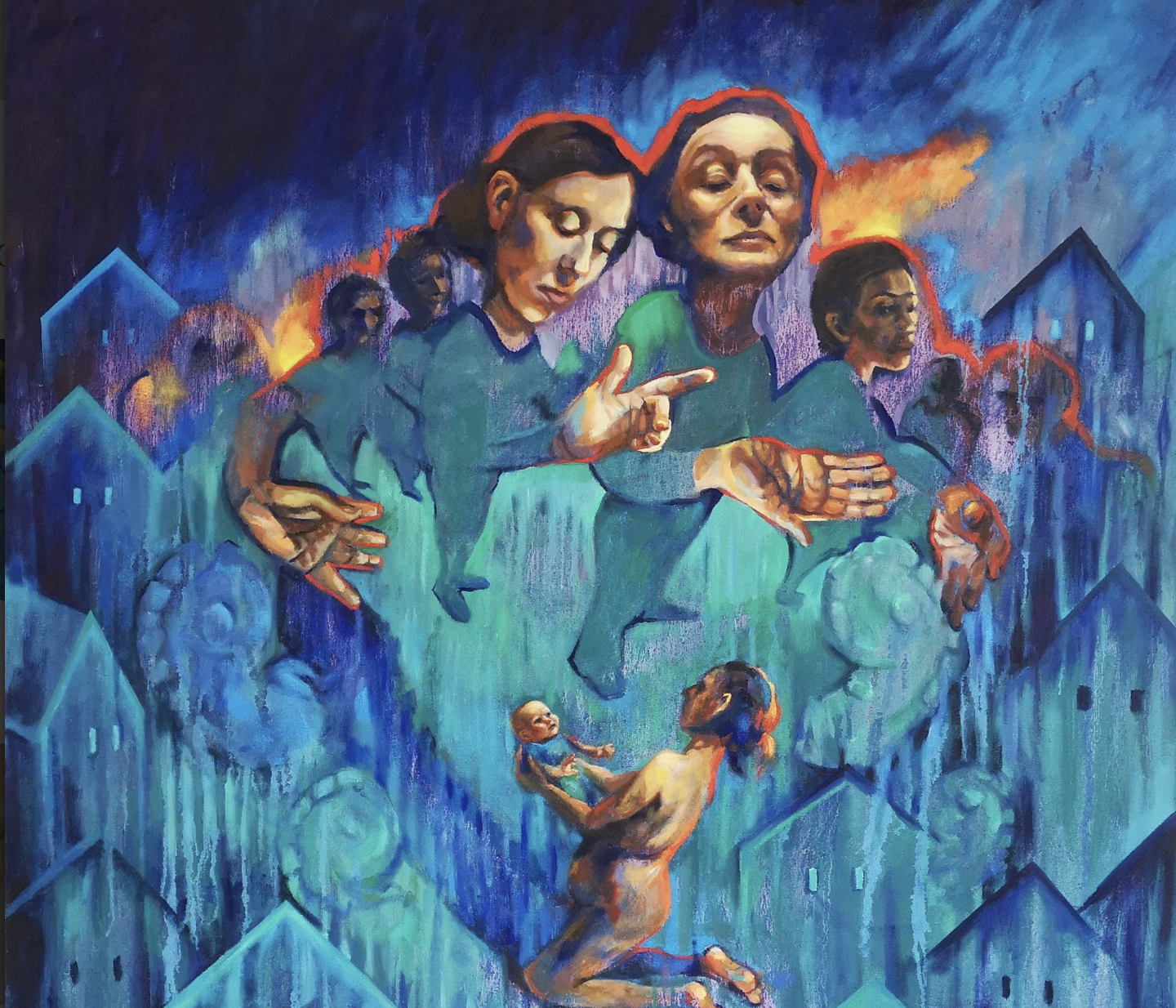
My practice is driven by years of not seeing people like me represented in the art canon. For a long time, I stopped making art altogether. Now that I’m making again, my purpose is to tell the stories of those who have been unheard, overlooked, or reduced to tropes. Much of my work explores motherhood, a theme often idealised in popular culture, and I aim instead to present it with honesty and authenticity.
I gather ideas through drawing, reading, and writing, developing them further through sketches and paintings before collaging compositions from these studies. I also practice printmaking and hope to do more of it, as its structured process helps me refine my sense of composition.
Oil painting is at the heart of my work. The medium allows me to move between control and freedom; from delicate, layered glazes to bold, saturated marks, embracing both restraint and intensity. These contrasts reflect the paradoxes of a living as a woman, the balance between care and selfhood, silence and expression, vulnerability and power.
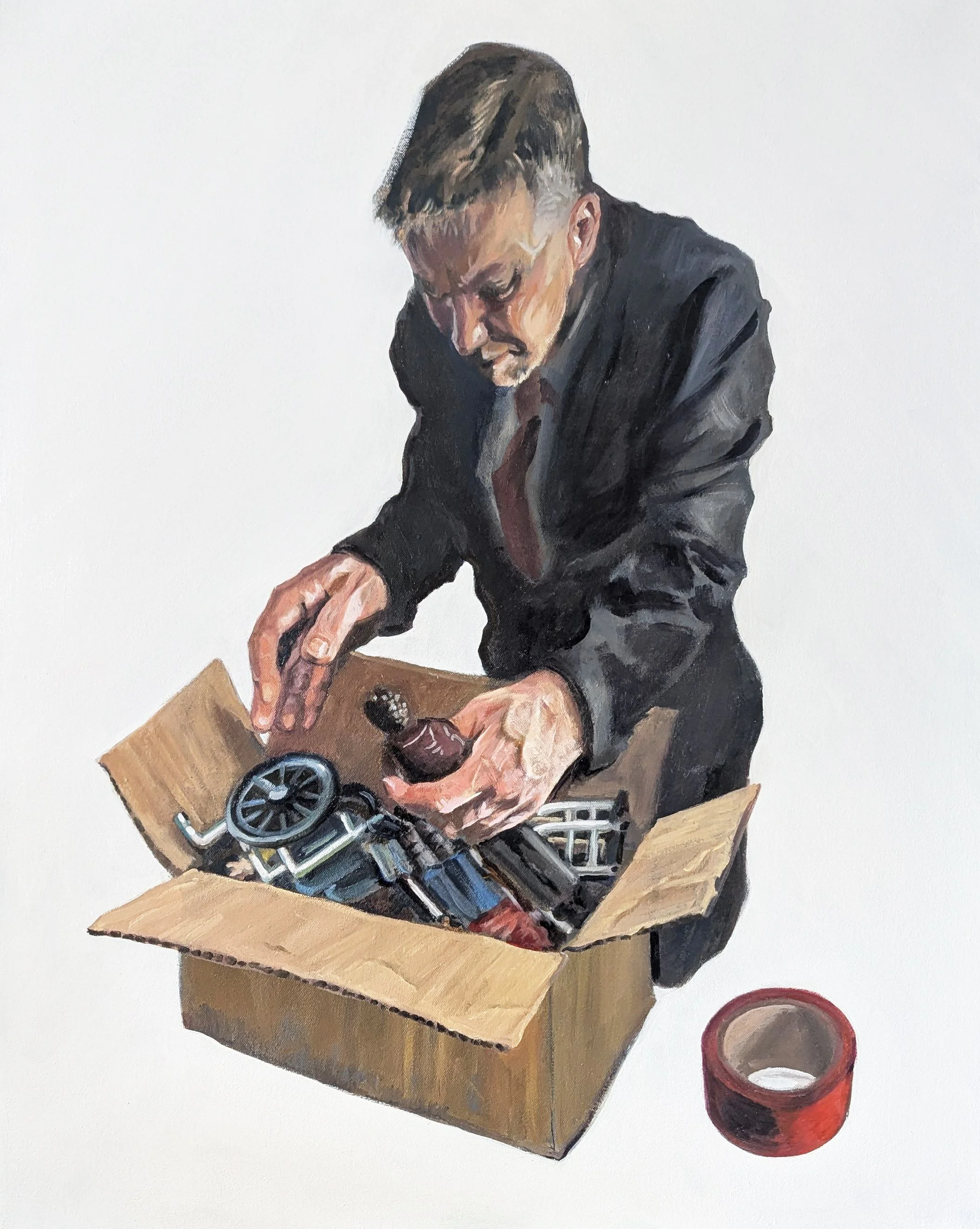
Portraiture and the human form have always fascinated me, and they remain central to my practice. Whenever possible, I draw and paint people from life, seeking to capture both their presence and their stories.
2 - Is art relevant today?
Art should always matter. It’s one of the most powerful ways we have to communicate; it can go beyond logic and speak straight to the heart. It can move us, unsettle us, or comfort us in ways that words sometimes can’t.
However, I often feel frustrated that art can still feel out of reach for many, and that it can be seen as elitist, both in who gets to make it and who can afford to experience it. I would love to see a democratised art world that feels open to everyone, where creativity isn’t limited by circumstance, and where voices from all parts of society can find their place and be heard.
3 – We are always asked what other artists influence us, we want to know what art you don’t like and which influences you?
As a painter, reality matters deeply to me, not in the sense of literal imitation, but in capturing energy and character. I’ve always been drawn to realist painters, from the Newlyn School to Lucian Freud. These artists revealed life in all its rawness, chaos, and grit, rather than presenting an idealised or polished world.
Paula Rego has been a huge influence on my work. I’m inspired by the way she weaves storytelling, myth, and popular culture together, her strong female characters, her dark humour, and her fearless exploration of uncomfortable truths.
I can appreciate art even when I don’t like its aesthetic, but I struggle with work that doesn’t feel authentic. Authenticity is hard to define, but for me, it’s about the clarity of message the work communicates and how that message integrates with the medium.
4- If you could go back 10-20 years what would you tell your younger self?
Eighteen years ago, I had a brain-stem stroke. There’s nothing I could say to my younger self that would be more powerful than that experience in teaching me that life is for living. It was the moment I began drawing again, realising I simply couldn’t live without art.
However, I always have, and still do struggle at times with imposter syndrome. If I could give myself one piece of advice, it would be to have more self-belief and to stop trying to please others. Your superpower as an artist is being yourself, no one else can do that for you.
5 – If you could go forward 10-20 years what do you hope to have done or not done?
As an artist, I would hope to have been able to continue working to produce a body of work that I am proud of, work that has a voice.
As a person, I hope that I have continued to be myself whilst supporting others around me.