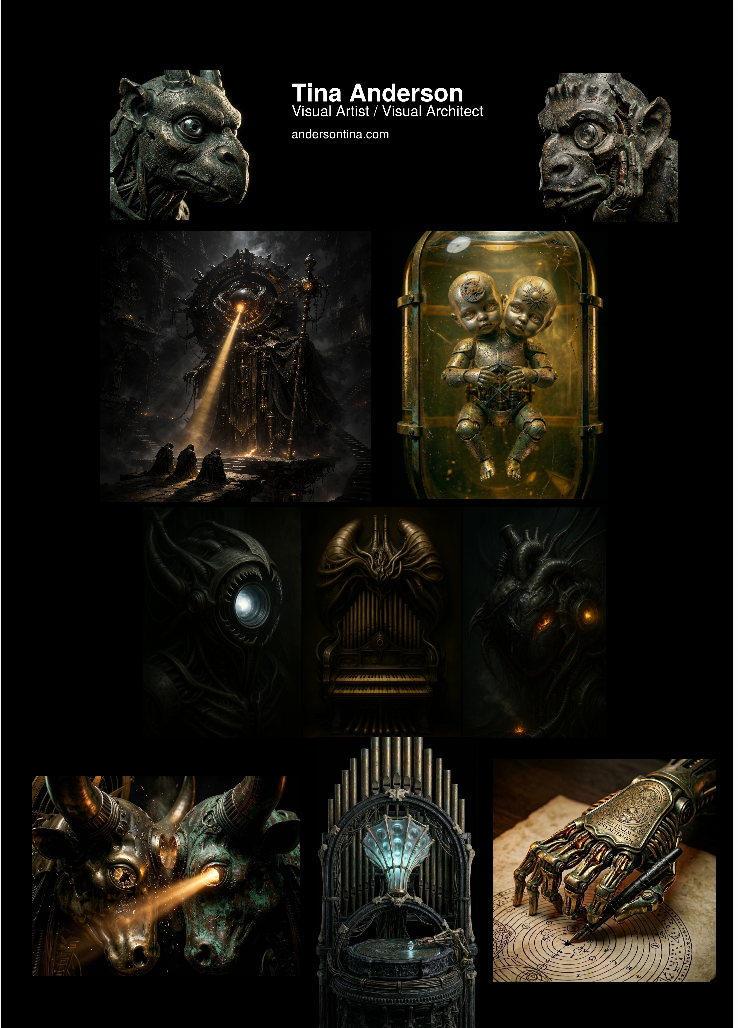
Featured Artist: Tina Anderson
What does a machine do when its Creator has gone?
This is the question at the heart of Tina Anderson's work, and it's one that lingers long after you've looked away. A visual architect and digital scenographer, Tina builds what she calls sacred machinery: biomechanical worlds suspended between divine blueprint and physical existence, between purpose and abandonment.
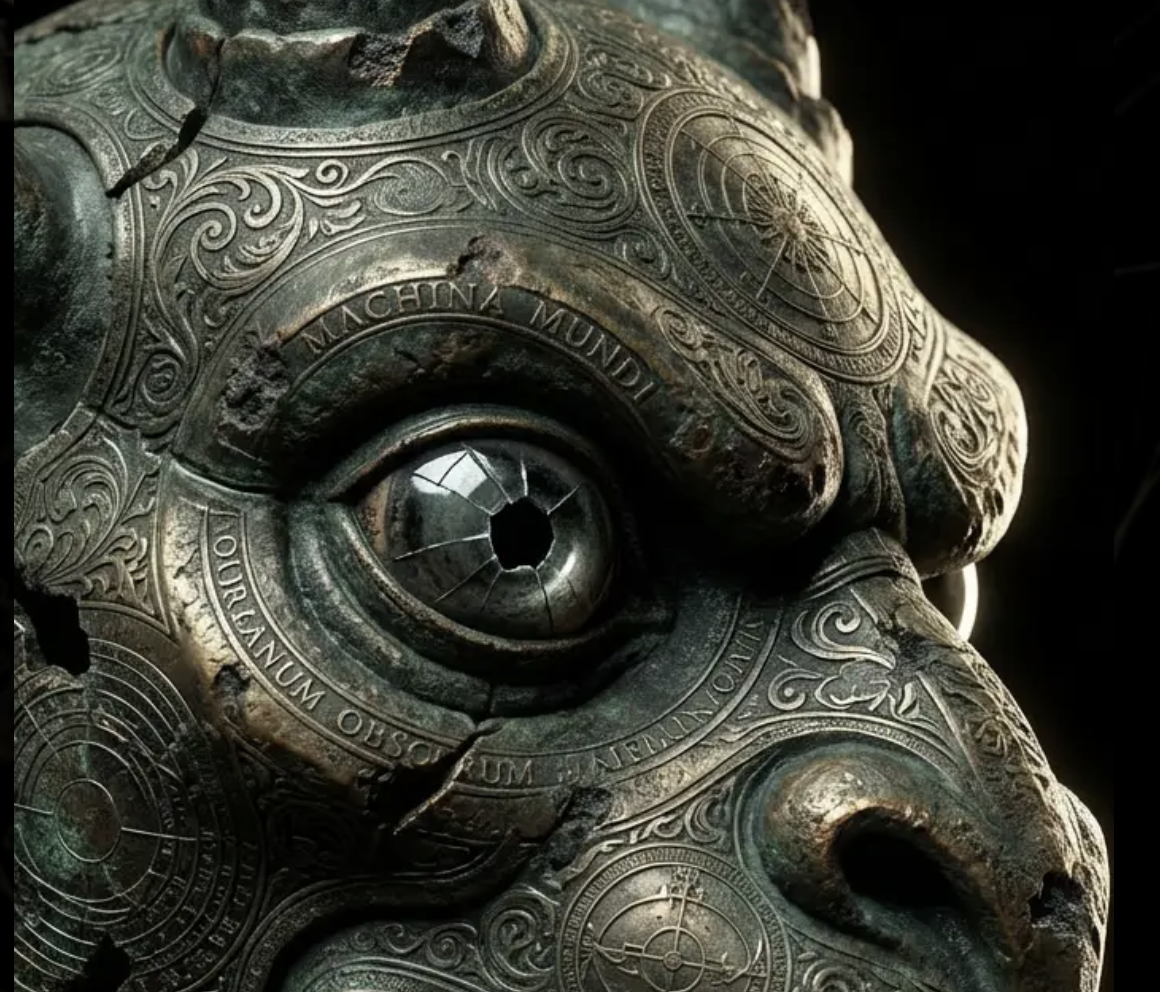
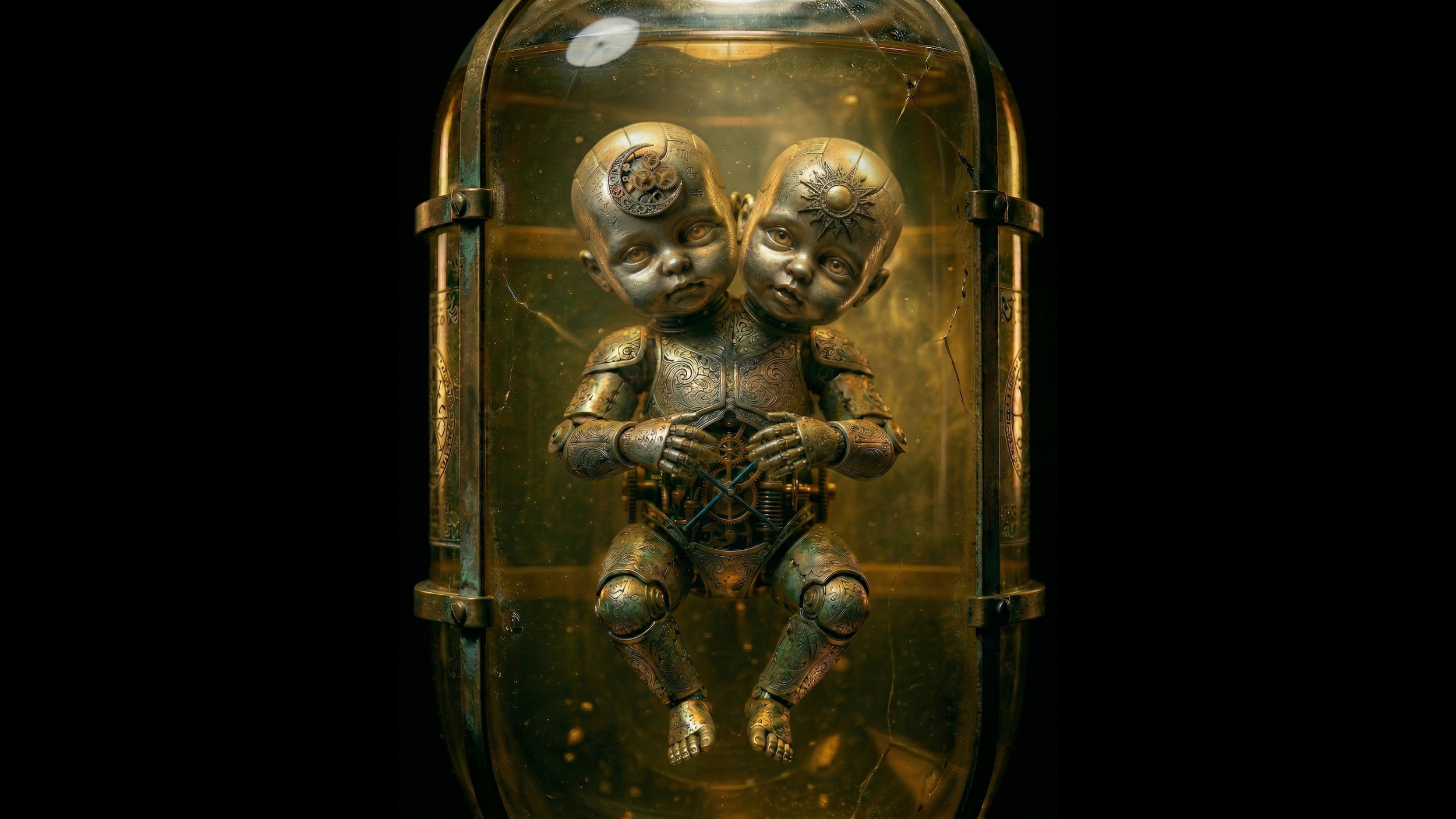
Her current cycle, Machine Hell / Organum Machina, is not comfortable viewing. It isn't meant to be. Drawing on baroque theatrical engineering, Kircher's cosmological instruments, and AI-assisted visual research, Tina constructs environments that feel less like artworks and more like relics, discovered rather than made. Machines still running. Signal long gone.
Is it art? Some will debate it. But that question itself is part of what makes her practice so compelling. When scientific devices become myth-making organisms, when light mediates between the constructed and the spiritual, the boundaries of what art is become exactly as unstable as she intends them to be.
Tina has exhibited across London, Milan, Paris, Osaka, Madrid, and beyond, and her work has been selected for the OSTEN Biennial Skopje 2026. We're proud to have had her among our exhibiting artists, and even prouder to shine a light on a practice through our Q&A and that reminds us creativity doesn't ask permission to exist.
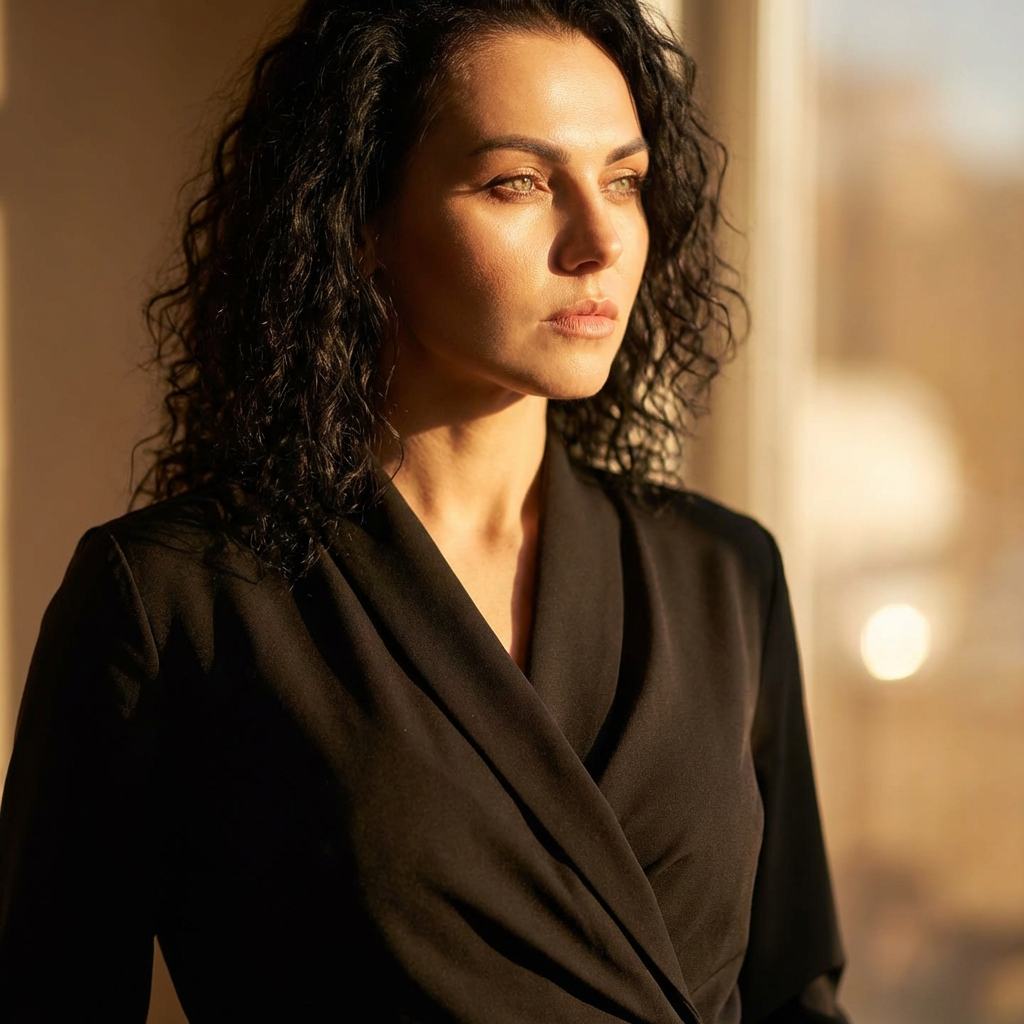
BIO - Tina Anderson is a Moscow-based visual architect working at the intersection of digital scenography, baroque mechanics, and biomechanical cosmology.
Her work extends the systems of Athanasius Kircher into contemporary visual structures, where machines function as organs and light becomes a form of judgment.
She is a selected participant of the OSTEN Biennial Skopje 2026 and has exhibited internationally across Europe and Asia, Latin America
Website: andersontina.com
Instagram: @tinaanders0n
new video -Just days ago Tina took part in a live stream on YouTube, almost a kind of initiation, where she spoke about her methods and practice. The response from artists around the world was more than Tina expected.
1 — Could you explain your practice?
I have always been drawn to strange art — art that is not like anything else. Broken, obscure, secret, occult, complex.
When I had the opportunity to create, I chose this path.
Athanasius Kircher is one of the greatest minds of his time. He made many remarkable discoveries, but many of them existed only on paper and were never realised, I mean his machines.
I reconstruct them, not as illustrations, but as artefacts that could have existed. I work as a visual architect, using AI not as a co-author, but as an optical instrument, a lens through which lost worlds become visible again.
2 — Is art relevant today?
Today, art is more relevant than ever.
The world is in a state of crisis, almost a kind of collective depression, and art allows us to see it from another perspective, sometimes painful, sometimes hopeful, sometimes through the innocent gaze of a child.
That is the role of the artist: to show the world through their own eyes.
My work reconstructs a past that never existed, but feels as though it should have.
3 — What art do you not like and which influences you?
I work with artificial intelligence and neural networks.
What I do not like is when there is very little of the artist and too much empty generation.
This is why many galleries consider AI art to be worthless, and I understand that, because when such a powerful tool is used without ideas, without knowledge, without narrative, the result is hollow. It creates something I personally do not want to look at. But when there is true refinement and authorship, it becomes something extraordinary.
As for influences, I have always been inspired by Renaissance art, sculpture, painting, and also Antiquity. Having worked in video and visual media for over a decade, and being trained as a historian of culture, I could never ignore this vast and beautiful layer of artistic heritage.
I am happy that I can now integrate it into my work.
4 — If you could go back 10–20 years, what would you tell your younger self?
I would say: the world will change, and it will change harshly.
But it will also give you the tools to survive and to find your way.
5 — If you could go forward 10–20 years, what do you hope to have done or not done?
I would like to preserve beauty. I would like to preserve great books and masterpieces of art, even if in a transformed form, so that people return to reading and rediscover a true understanding of what beauty is.
Before it is too late.