
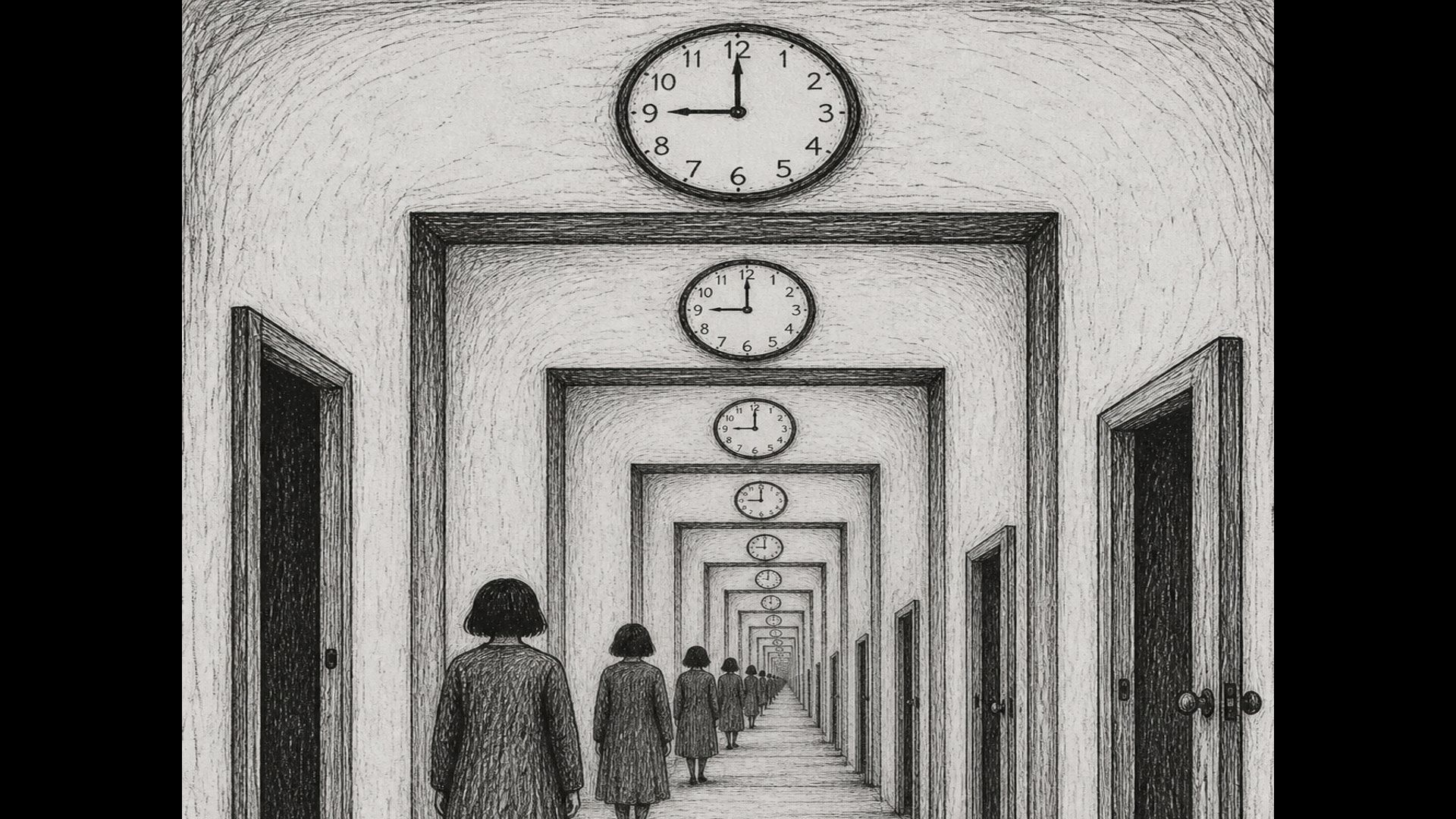
The Liminality of Time: Portals, Pauses, and Transitions
Welcome to an exploration of the thresholds where time dissolves. For this issue, interdisciplinary practitioners and writers investigate how moments stretch, contract, and defy linear measurement. By centring on twilight hours, states of waiting, and endings that feel like beginnings, these works inhabit true liminal zones. Explore a collective literary space where chronological certainty loosens, and deep, artistic transformation becomes possible.
Poet Peter Devonald
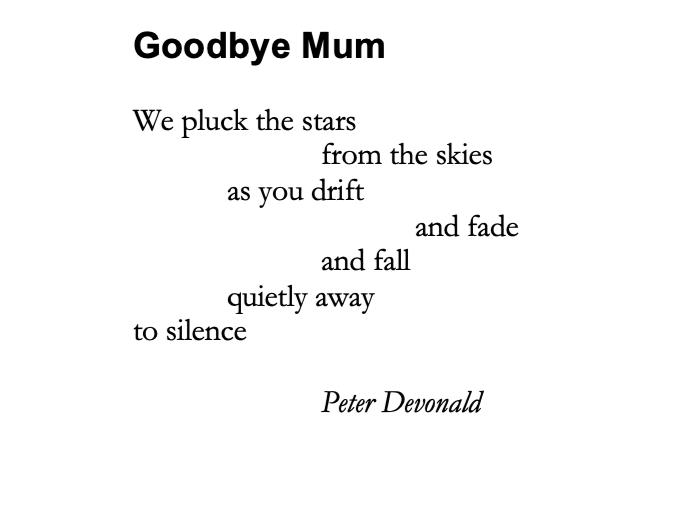
a serenade to nowhere
we cradle our memories fearful of the violent loss
the blueness of the lake your face lights up
as it always does talking of nature
talking to strangers engaged with grace
flowers bloom everywhere you go
miraculous fairy tales only for children now
we hold your hand not if only when
Peter Devonald
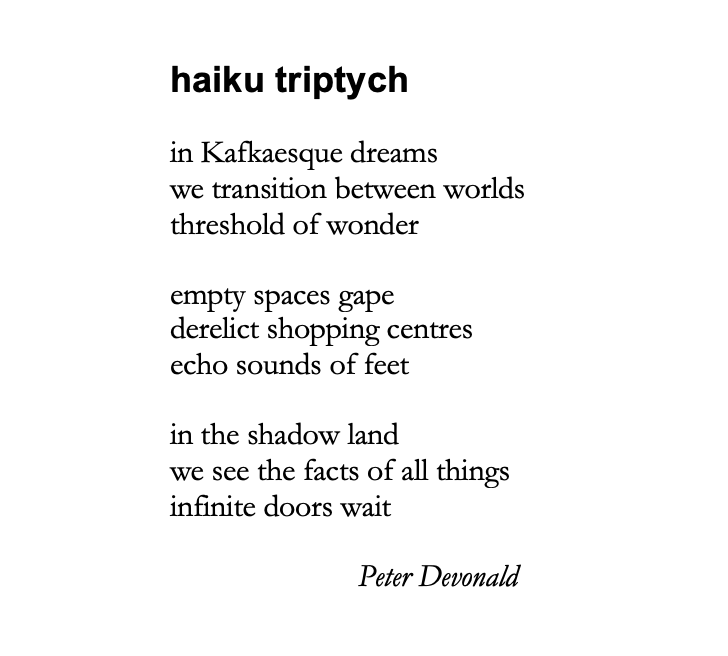
⌛️⏳🕰️⏰………⌛️⏳🕰️⏰………⌛️⏳🕰️⏰………⌛️⏳🕰️⏰………⌛️⏳🕰️⏰………⌛️⏳🕰️⏰
Michaela Hall
The Marks of Time
Time is something so fixed yet so elusive, we all follow the rules of time and live our lives by the clock, so much so that when we think of time, the most obvious visual indicator of time is just that – a clock, numbers, and systems. Our actions and how we live also mark time though, they mark our environments that then become records of time and lived experience.
This is something explored by Japanese artist Chiharu Shiota in an abstract yet tangible way. Something which I think deserves a sole focus within this theme as it is a completely unique representation of life and time.
Shiota is famous for her huge, immersive and eye-catching installation works. Through the beautifully intricate yet chaotic weaving of threads in a space, she represents movement in the space, often referring to time passing and how the space has been used. The spaces become intermingled in terms of happenings, one thread that was woven at a certain point might get stuck or tangled on an object that then gets overlapped by another to represent another point in time or another ‘happening’. In her ‘Threads of Life’ exhibition this year at the Hayward Gallery, we see red and black threads take over very different spaces, they are abundant and weave around the focal points of an open door and beds lined up in a room. The spaces have us making up our own stories about what may or may not have happened in these rooms over time, and why the threads have been placed in the way they have.
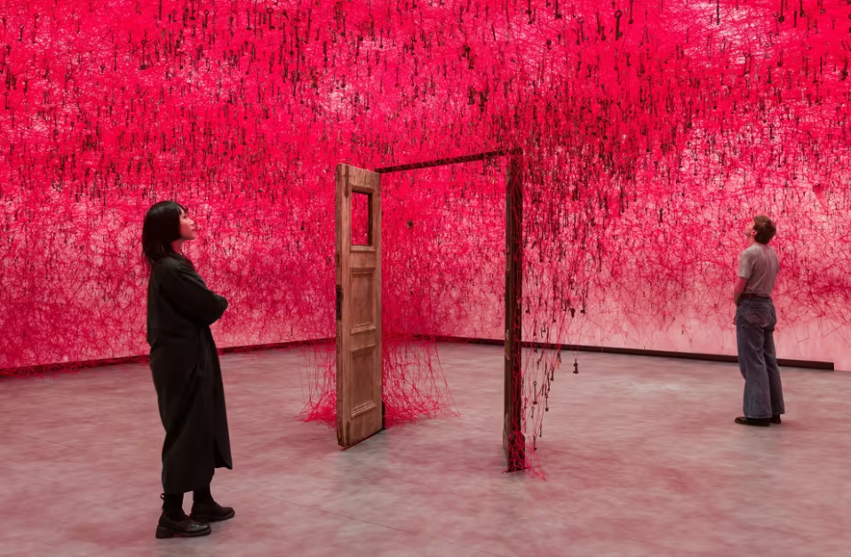
(Installation view of Chiharu Shiota: Threads of Life. Threads of Life (2026)
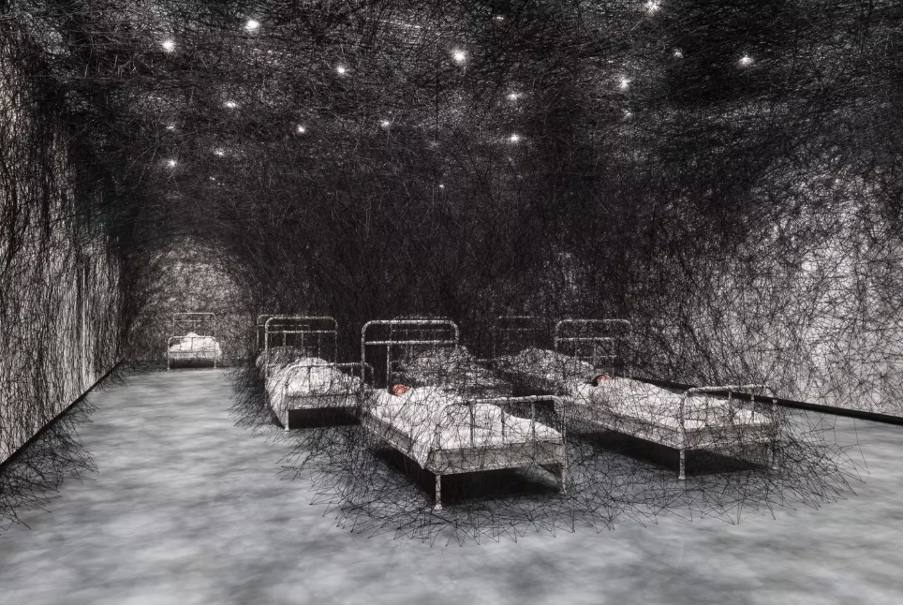
(Installation view of Chiharu Shiota: Threads of Life ,During Sleep (2026) Installation view of Chiharu Shiota: Threads of Life. During Sleep (2026) Photo: Mark Blower. Courtesy of the Hayward Gallery. © DACS, London, 2026 and Chiharu Shiota.)
Not only do these pieces look very visually intriguing, but they are reminiscent of mapping and how we decide to spend our time. Whether it’s via a conscious approach or by being in autopilot, these threads and their placement represent multiple decisions and actions over time. There’s something quite moving about thinking how different the installations could be if they came from different artists or different spaces with different happenings.
The threads, as bold as they are in unison are obviously gentle and fragile in nature, and there’s something about this in conjunction with what they are representing that makes time seem looser as opposed to how we may think rigidly about it usually.
What Shiota manages to do with a very normal material, is get us thinking about time itself, how we spend it and how this marked in both the exhibition space and our own lives.
⌛️⏳🕰️⏰………⌛️⏳🕰️⏰………⌛️⏳🕰️⏰………⌛️⏳🕰️⏰………⌛️⏳🕰️⏰………⌛️⏳🕰️⏰
Artist name - Norman Miller
Website - https://normanmiller61.journoportfolio.com/
Socials - @viewsfromthenorm
SYNOPSIS
These three poems relate to the theme in their shared exploration of sometimes almost hallucinatory aspects of time. 'Keeping Time' expands on the definition of the second to landscape level, 'Mirrorlands' plays with timelines, while 'Child, Remember' dives into the timelessness of memory.
Keeping time
“The duration of 9,192,631,770 periods of the radiation corresponding to the transition between the two hyperfine levels of the ground state of the caesium 133 atom.”
SI definition of a second
We are always in motion, even at rest.
Hearts drum, neurons crackle with quanta,
and every second marks nine billion
transitions of an atom named sky blue.
It's there in the slow dancing of plants, twisting
around light, scaling walls, letting us tend them
in awe of their connection to underworlds,
uncertain if they are new born or risen dead.
It's there in music - how a note can contain a year,
two notes a decade, a riff a life,
within you, without you, defying senses,
time dissolving into memory and reflex.
It's there when erosion tries its patience
pitting oceans against chalk cliffs,
sea churning sediment like dark ale, until
bone shorn of skin is reborn as Seven Sisters.*
(*The Seven Sisters are a famous sequence of chalk cliffs on the south coast of England)
Child Remember
Hong Kong, somewhen, energies
beating out my shape, back when
I was born, and a snake crossed my path
in the jet-black of a young dark
before I knew anything
a snake crossed my path
a fallen thing blocking
the way home in the first garden
where lychee grew up and up
and we plucked them from a balcony
high as sky, rooting into earth
where a bough that was not a bough
that was a snake in the dark night
of a child, four, maybe five, a long
shadow, sliding to its welcoming bush.
The decades are gone, are aeons, slipping
5000 miles back to the Old World
in my head, in my skin & the eternal bone
in a black light blazing across
synapses in billions, unforgetting
the snake that crossed my path
that I did bend to grasp
sliding into the bush
in black night.
Mirrorlands
Come, walk in the other cities
mapped between temporal twists
flickering with jittering alternates,
timer sands of all the unsaids
as shifty as love, of ink settling
in tattoos you never got
a night you drank past closing,
locked-in with one for the road
over which a partial moon curved
spooning against a night you kissed
and slipped inside, within the night
you bit your lip and walked.
The future is past turned in another light,
a ceaseless chorale in quantum parts
of all possible songs in different registers.
Nothing is stasis, stasis is nothing.
Even continents move against each other
grinding in geological slow dance.
We travel endless lines on one way tickets,
unseen points shifting as scenery years pass:
railroaded – but constantly arriving somewhere.
⌛️⏳🕰️⏰………⌛️⏳🕰️⏰………⌛️⏳🕰️⏰………⌛️⏳🕰️⏰………⌛️⏳🕰️⏰………⌛️⏳🕰️⏰
Artist name - Garima
Website - https://www.amazon.co.uk/dp/B0GL9GQR21
Social - @garima_s_k
The poem is titled The Liminality of Time because it explores the feeling of existing in an in-between space, where the memory of past no longer means that the present feels calm and the future remains uncertain. In moments of war and geopolitical instability, time itself begins to feel suspended, fragile, and altered. Ordinary life continues, yet it is overshadowed by decisions being made far beyond the control of everyday people. The poem reflects this emotional threshold, a collective waiting, grieving, surviving, yet still hoping within a world that feels permanently on the verge of change.
Liminality of time
The liminality of time sits quietly now, between the before and the coming.
It isn’t marked by clocks, nor by the digital calendars we now use
But by headlines that arrive before draw our curtains open
And mums refreshing the news with trembling thumbs.
We live suspended between ceasefires and sirens,
Between airport departures and long wait times on customer service calls,
Between the language of diplomacy and the internalisation of grief.
Somewhere, men in tailored suits draw borders across conference tables
With the ease of moving chess pieces, while elsewhere, a child learns
that the sound of a football being kicked and the sound of panic
can echo through the same street.
And still, morning arrives.
Tea is poured.
Uniforms are ironed.
A dad waters plants on a balcony
overlooking a city that has learned
to carry anxiety so very elegantly.
The Middle East has always known
how to survive beautifully.
But time has changed it’s persona here.
The future no longer stretches forward like an open road.
It flickers.
Conditional. Fragile. Negotiated
Behind doors clicked shut by people
who will never hear the trembling in our ordinary, innocent voices,
Voices still trying to show our children
that safety can feel grounding, tangible and obvious.
⌛️⏳🕰️⏰………⌛️⏳🕰️⏰………⌛️⏳🕰️⏰………⌛️⏳🕰️⏰………⌛️⏳🕰️⏰………⌛️⏳🕰️⏰
Artist name - Julie Dexter
Website – www.juliedexterwriter.com
Social - @Latenighswimmer @JulieADexter @juliedexterwriter.com
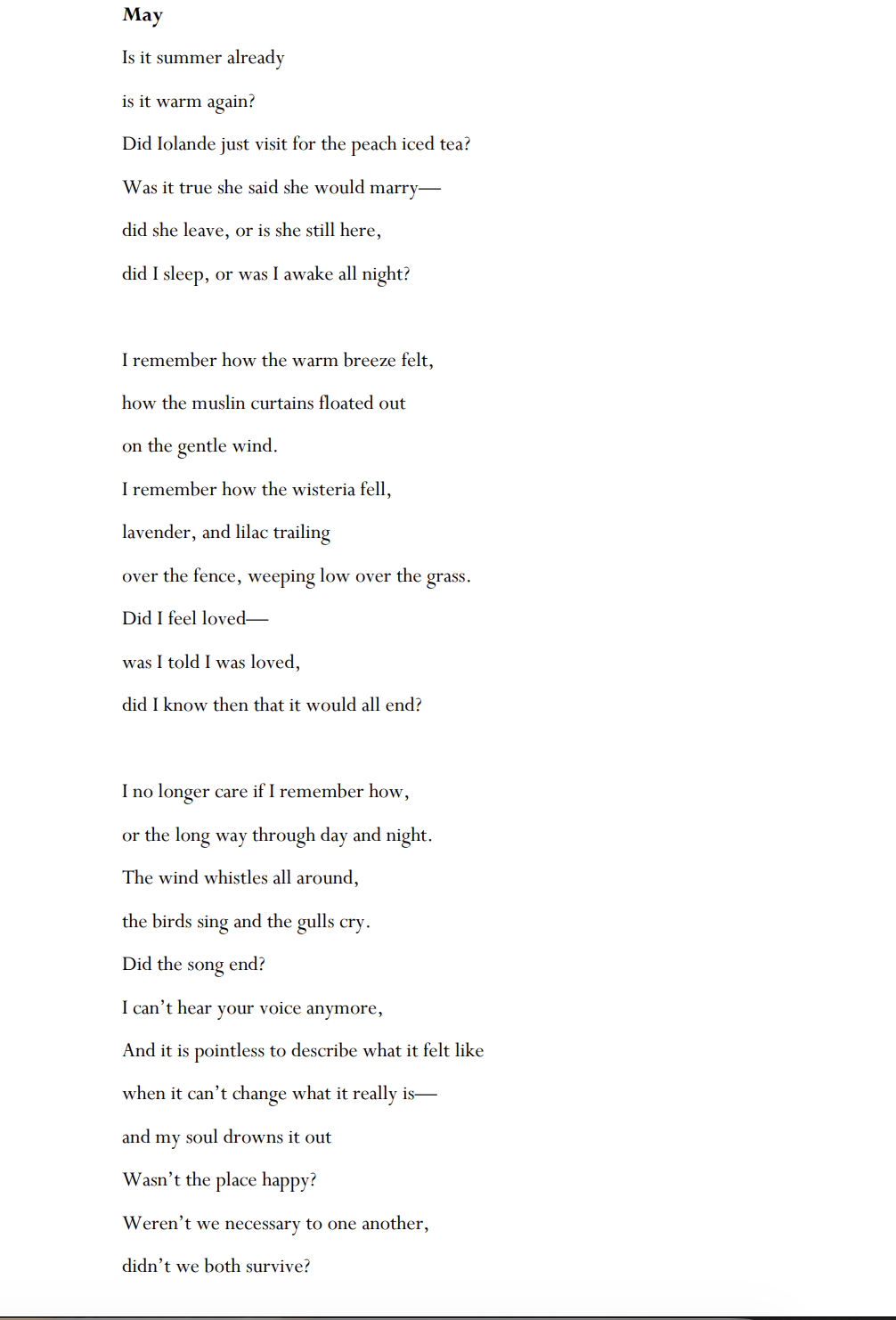
The poem, May explores the instability of memory and emotional time following transformation and loss of a relationship. Through fragmented recollection, seasonal imagery, and repeated questioning, the poem inhabits a liminal space between presence and absence, where time feels nonlinear and suspended, and felt moments continue psychologically beyond their ending.
⌛️⏳🕰️⏰………⌛️⏳🕰️⏰………⌛️⏳🕰️⏰………⌛️⏳🕰️⏰………⌛️⏳🕰️⏰………⌛️⏳🕰️⏰
Artist - Nino Memanishvili
Website - www.ninomema.tumblr.com
Social - https://www.instagram.com/memanishvilinino/
Synopsis for Poems:
These poems capture the emotional and existential weight of living within temporal thresholds. Through shifting imagery of contrasting landscapes—inside versus outside, structured rules versus chaotic transitions—the text explores the friction of constant adaptation, defining the human soul not as a static observer, but as a participant in time’s unpredictable occurrence.
It Happened So
Standing on the balcony,
Catching raindrops,
Heavenly dew gently sprays beneath.
It will remind you of the day
The moment of life enters the realm:
She, the beautiful and kind, You, helpless and a coward!
Somewhere, thunder and lightning,
Here, the dew nails the lane.
She gazes with amazing eyes,
And her smile flickers.
It is better if we meet somewhere,
Or now, it rains for sure.
Poems are not written,
Poems occur, Like an epic event,
Like something unexpected,
Like an occasion or even an accident;
And the soul is only a participant.
It was not written, it happened so,
This happens usually like an earthquake,
Like a rainbow,
Like a thunderstorm,
Or as if an angel had cleansed the tears.
Something happens there, without a doubt,
As it happened once, in ancient times.
Inside / Outside
It is windy outside,
I have a warm heart inside.
As if it snows outside,
As if your heart beats inside.
Why do you not want to hear? I want you to be near.
As if we were thinking,
Tears may have a meaning.
Forbidden could be feelings,
For forced and doubted beings.
Secreted could be worries,
While hiding real stories.
Dreams would be so sorry,
Rejecting holy glory.
In the heart of the mourner,
Sense would set agony.
Only winning and losing Could be really funny.
Only loving and flying... Oh, love, that’s why I am dying!
Dodging bullets in time, Burning, running, and flying.
Corpses are brought inside,
It is not warm outside.
Weeping days and all nights,
Horses winning the fight.
A dog's bark is heard inside,
It is foggy outside, Easter morning is coming.
A wolf's dance is seen inside.
Tiring may seem life,
Lost on finding wine...
Lions shed tears inside,
Freedom is gone, and I am crying.
It is raining outside,
It is your heartbeat inside.
A bell rings outside— Call the priest! Say, I am dying.
⌛️⏳🕰️⏰………⌛️⏳🕰️⏰………⌛️⏳🕰️⏰………⌛️⏳🕰️⏰………⌛️⏳🕰️⏰………⌛️⏳🕰️⏰
Artist - Jun Haeng Lee
Website - https://junhaenglee.cargo.site/
Social - https://www.instagram.com/_junhaenglee_
Synopsis
The Unobserved Exhibition sits inside liminal time, which is the suspended interval between one observer leaving and the next arriving. Through the contract of observation, it argues that time is not physical but relational: without a witness, the exhibition holds every version of itself at once, neither before nor after.
The Unobserved Exhibition
Now we enter the exhibition. You and I made a contract. It is invisible, signed at the threshold. The door closes. In here you agreed to walk slowly, stand individually, be as silent as possible. You agreed to observe, participate, and be present with the artwork. And then you left.
The existing exhibition model is built on an assumption that the audience will travel for art. As soon as they enter the exhibition space, they are signing to the invisible contract that they will participate in a certain form of encounter. Even though it is invisible, they know what they are signing up for. This could be simply called as ‘contract of observation.’ In the exhibition condition, what kind of presence is expected, what counts as the right way of participation to be in a room with a work?
What do we observe, and what is the act of observation?
The most important question is: what happens to that contract when the observer disappears?
There is a theory that observation is not passive reception but active intervention: the world choosing which version of itself to be in the moment of the observer’s presence. The encounter does not begin with the work and when it reaches the observer. It occurs between them, in the gap, and both parties are required to bring it into reality.
I have been thinking about this in relation to what the exhibition space is doing when there is no observer.
The wall does not know whether it is being looked at. The label and description beside the artwork do not know whether it is being read. The light touches the surface of the work whether or not a human eye catches that moment and makes it mean something. Physics continue. Entropy continues. However, what about the narrative of the exhibition that is not relational to the physical time and space? Would it fall apart or fall into superposition, held in between existence and disappearance?
That means it requires you, the observer.
Structure is relational. I would say exhibition space itself and space within them too. It is produced in the gap between the work and the person who moves through it. Sentences are not writing until someone reads it. A map is not a guide until someone unfolds it and looks place up. The space between two pieces is not claimed until a body moves through that space and activates the friction. The subject needs the observer as the observer needs them to be ‘observer.’
Now you have gone, and the space between the pieces is frozen. Narratives are suspended, and now time is held in between the threshold with the exhibition.
I want to be precise about what I mean by this, because it is easy to mistake it for a claim about value. Argument about value is not the question I am asking here. I am asking something more specific: whether time in this room is still passing. I do not mean physical time that human-kind made an entire equipment, the clock, to precisely divide and measure it. But the time which holds the temporal experience that require an interaction between the subject and the observer to cause friction and critical intervention in the space.
‘Before’ and ‘after’ are not physical time-related categories. They are experiential. They require someone for whom the experience is activated. Before means when the visitor enter, stands in the doorway, steps in the room. After means when the visitor has crossed the threshold, is now inside it, breaths in the exhibition and then leaves the space. In the absence of that someone, the room does not move from before to after.
It is suspended.
The exhibition is not waiting. Waiting implies anticipation, and anticipation requires time, and time is exactly what is questioned. What I want to say instead is that the exhibition space is held in the last state it achieved before you left, which was the state of being looked at, which was the only state in which it could be said to be doing what it was made to do.
What it was made to do was make something happen in the space between itself and you.
Without you, that space is not empty. It is every version of itself at once, and therefore no particular version at all. The work on the wall is simultaneously seen and unseen, read and unread, understood and misunderstood, moving and still. All of its possible encounters coexist in suspension, none of them falls into the specific condition.
The contract cannot be completed without both parties present.
The door will open again. Someone will come, possibly tomorrow, maybe next week. The temporal interval that the space will experience will be neither long nor short, because the room is not experiencing anything. They will be in the threshold. Then when would the next ‘Before and After’ occur?
Until that question is answered, I am here.
Waiting but not waiting.
⌛️⏳🕰️⏰………⌛️⏳🕰️⏰………⌛️⏳🕰️⏰………⌛️⏳🕰️⏰………⌛️⏳🕰️⏰………⌛️⏳🕰️⏰
Artist - Hilary White
Website - https://linktr.ee/hilaryreidwhite
Social media accounts - @hwhilary
Synopsis
The attached document contains two extracts from a novel-in-progress titled Productivity, about doubling, sleep disorders and neoliberal academia. The protagonist is a chronohilosopher with Delayed Sleep Phase Disorder studying abnormal experiences of time – which I think connects very well to your theme on the liminality of time! Thanks for reading.
Productivity (excerpts)
Excerpt 1
I woke late, groggy from an uneven sleep. Spent the dull morning hours mainly in a hypnagogic state, my favourite to occupy, one which for much of my life had been unavailable due to the requirements of school or work, taking place as they did at specific and too-early times. I had in fact spent much of my life sleep-deprived, never really knowing what restedness felt like. Weekends were not enough. It took years of self-directed research to establish my preferred hours, longer because of culturally embedded pressures to function early in the day. Had these not existed, I might have discovered decades earlier that I was not in fact an insomniac, that I could sleep fine so long as I could do so on my own hours. Only in the fourth year of my doctoral degree did I realise that I could not wake comfortably before eleven not if I was to be able to use my brain that day. I recalled the years of being called lazy or eccentric, not so disagreeable really, but hurtful to someone who internalised guilt due to their supposed difference. Had I not entered academia, I may never have realised this, may have continued through life under-slept and perpetually nauseous. I suppose I could credit academia with this one personal benefit. Unfortunately like most jobs which granted freedom surrounding time it was unevenly paid.
Making coffee slowly and returning to bed, I went through my morning routine of sitting in bed, book in hand, struggling to focus on the language. There was something about this return to a pre-linguistic state, or a state before which reading comprehension is possible, that appeals to me as a way to begin the day. Awakening into a process that leads nowhere, not even towards enlightenment: awakening into blankness, or garbled noise. Awakening without the requirement of understanding any of the messages making their way toward you. Awakening into a state not so different to the sleep or dream just left, so that the transition could be slower, less jarring. Anyway, my morning reading accomplished, I sat and thought uncomprehending thoughts, before looking at my phone for longer than intended, a less pleasing way to accomplish nothing.
It was one p.m. before I opened my laptop, with an eye to starting work, by which I mean the unpaid section of my work, which was its bulk. I was working on my latest postdoctoral applications, starting to widen my parameters, opening up to various European locations. Previous rejections within the island had been accompanied by concerns about what it was I would actually be doing with my day-to-day and who would profit from such an anticapitalistic endeavour: innovative in theory, but what’s the use?; what can dropping out do for time studies?; what kind of external organisations could you partner with in this study of idiosyncrasy and solitude?; why should the University invest in nothing?; what makes your investigation of inertia really, truly attention-grabbing? I was met, on awakening the laptop with the smiling face of my newfound rival. I had forgotten about my frenzied searches of the night before. On re-reading the first few lines of her bio, it struck me that she was undertaking a postdoctoral project. I hadn’t remembered this piece of information, or had somehow missed it on a previous read-through. Immediately hit by a wave of fatigue, my first thought was to return to sleep. Competition of any kind usually made me respond in this way. I felt under too much oblique pressure to nap now, so I set to questioning my reaction to the news, my perceiving it as competition. Why was I being so defensive? Was my identity so wrapped in my academic interests? Was this a healthy approach to research? Perhaps it was no great problem to have multiple people studying abnormalities of time; it would, after all, only raise awareness that disordered experiences of this kind were a possibility. This is how I wanted to approach the situation, intellectually. Perhaps a serial achiever could even offer a new perspective to the field of nonstop inertia.[1] Perhaps this would be by getting something done. It occurred to me then that most scientists studying sleep abnormalities seemed to be free of disorders themselves. Otherwise they would never undertake a degree programme with so many morning contact hours. Among so many turn-of-the-century insomniacs, Sigmund Freud slept remarkably well. Should I just give up now? If I did in fact have something unique to offer the field, the question on every reviewing committee’s lips, would I have the wherewithal or even the energy to deliver? Since I certainly would not have the wherewithal nor the energy to do the opposite and start something new, I could not entertain these thoughts for long. The somehow enhanced closeness of her terms, and the meanwhile ongoing precariousness of my position, meant, however, that I could only see this news in terms of the work it meant I still had to do. I would have to rid my proposals of any semblance, retreat hastily from the position I had eked out so meticulously and over so much time, for reasons totally unrelated to the research itself, because of outside pressures only. Even imagining the effort was too much.
Excerpt 2
On the day of the lecture, I was awoken from a deep sleep by my eight a.m. alarm, a time I knew was too early for my physiological composition, but a time at which I had to arise in order to attend the lecture, for it was a morning lecture, scheduled to begin at ten a.m. Years of training and the wisdom of age meant that I knew I had one chance to arise, and if I did not, I could say goodbye to whatever my morning plans were. I therefore suppressed the part of my brain signalling pain and various other forms of alarm, suppressed the noise of my actual alarm, and immediately got up from my bed. I felt wretched. The pressure on my eyelids was but a whisper of what I knew I could expect later in the day, a type of foresight gleaned through a lifetime of experience of fatigue headaches and brain fog, totally avoidable except for the routine patterns of the waking world. Working in non-academic jobs didn’t necessarily make the brain fog more sustainable, but there was the peculiar difficulty of trying to push through it in order to process linguistic information and try to have thoughts about it. This was the tenor of my mind on mornings when I had to get up early, conditioned pessimism it became difficult to escape because of the physical effects I knew now to expect. After some time spent wallowing, I made breakfast, despite my growing nausea, knowing it would in fact be worse if I didn’t eat, knowing too that the nausea would last until I was properly rested, which is to say until I could sleep uninterrupted until eleven. Eleven was a personal miracle, for a decade ago it had been two p.m. My training had carried me this far towards the morning being bearable, and I have to say, it made be a bit proud. I had internalised the lark supremacy, the deep-seated cultural, embedded to the point that it felt natural, even primal, preference for early rising. I felt a certain pride too in my physiological resistance to the capitalist work day, in my natural alignment toward the night, though there was something unshakeable about the good feeling accompanying the morning, when I did not awake halfway through the day: the promise that it held, which is to assume that only beginnings are promising, while endings or near-endings mean dwindling, depletion, unconsciousness, merely a pause before the next day can begin with renewed promise, or to accept the conventional beginnings and endings of days, so that to begin late meant foreshortening, cutting the day short before it even got started. Even my eleven a.m. awakening could sometimes provoke shame, or at the very least stress, when I woke to an accumulation of work emails which had been piling up since the early morning, for the work day advanced further and further for some, presumably because it suited them to also finish early, for this was the chronotypical majority, or if, as is routine, eleven a.m. was actually just my base awakening time, but then I snoozed for a bit, drank coffee in bed, prepared slowly for the day, showered, dressed, not without haste but certainly not with it, and suddenly it was what the rest of the world deemed to be lunchtime, so forcefully that even I referred to it as lunchtime, when it was nothing of the sort for me personally. So many people had simply accepted this fact that it became natural, normal, crept even earlier, for suddenly a lunch could happen at noon, eleven-thirty even, for the day had already gone on long enough for some, by eleven-thirty even, while I had not yet touched my morning coffee. The time escaped me, as it always seems to do in the morning, moving more quickly than my participation in it, the first period on waking stretched out, the period closer to the time I had to leave the house compressed, so that I was moving first languorously, necessitated by drowsiness as much as habit, then suddenly, by necessity, having to rush to shower, pack my things and perform the bare minimum of tasks required to ready myself to leave the house, in order to not miss the one bus I could still get to make the lecture on time, for which I had to run, as the minutes had slipped away and I was, as always when it came to making morning deadlines, running late.
[1] Lisa Baraitser
⌛️⏳🕰️⏰………⌛️⏳🕰️⏰………⌛️⏳🕰️⏰………⌛️⏳🕰️⏰………⌛️⏳🕰️⏰………⌛️⏳🕰️⏰