
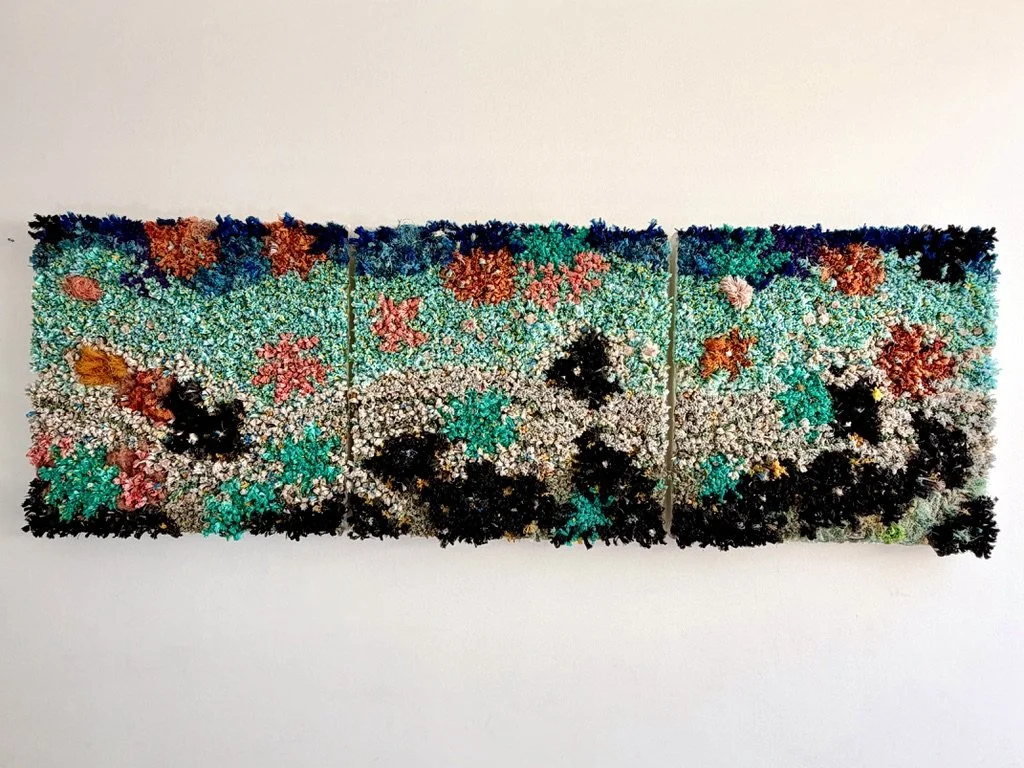
Our Feature this month you may recognise as They were a resident of Haus A Rest a few months back, here Francesca talks about her practice and answers our questions.
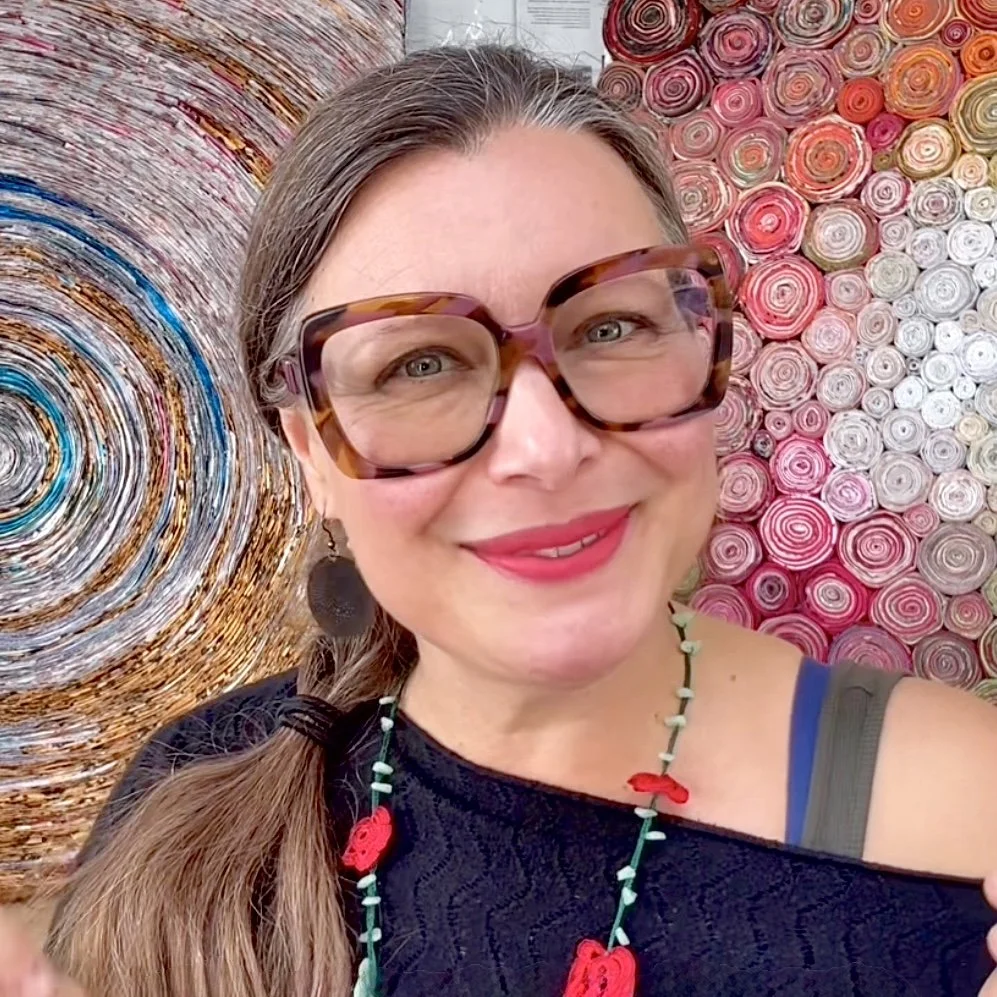
Bio - Eco‑artivist , Rubbish Artist, Waste Mosaicist. Weaving Trashure into meaning and responsibility. Using art as a universal language for empathy and systemic change. Founder of ArtforTrash and GREENy bastARTs
1 - Could you explain your practice? Only you know why you do what you do.
My practice is rooted in eco‑artivism: I use discarded materials — my trashure — as my prime medium, not only to avoid plundering Mother Earth any further, but to challenge the way we define value. Waste is a cultural construct. We decide what is precious and what is worthless. By transforming rubbish into mosaics, I invite people to question those assumptions and to recognise the beauty, dignity and potential in what we so casually discard.
My process is resourceful, intuitive and adaptive. I make do with what I have — and I love the creative challenge that requires. Sometimes it takes years to gather enough material for a piece. It’s getting easier and faster with time, as I now rely on local and global communities across different sectors to collect material for me. There’s little more exciting than coming home to find a bag of trashure left at my door.
Each series calls for different materials depending on the theme and the research behind it, so I keep a base selection of elements I know are particularly expressive — fruit nets for colour, cork for consistency, medicine vials for shape and elegance. And of course, I enjoy experimenting with new materials each time, depending on the issue I’m focusing on. That responsiveness mirrors the ecological truth that everything is interconnected and constantly shifting.
But the material is only the doorway. My deeper aim is to spark empathy for the entire ecosystem — its species, its flora, its fauna, its fragile interdependencies. I want to help shift mentalities from an anthropocentric worldview to a holistic one, centred on the common good of the whole living system, and to inspire viewers to consider such a systemic change.
This ethos extends into GREENy bastARTs, the eco‑artivist collective I founded to bring artists, scientists, activists and communities into the same conversation. Our flagship project, Kindfire, is the artistic heart of London Climate Action Week — a ten‑day eco‑artivist exhibition with a weekend of panels, workshops, performances and climate‑action sessions designed to empower people and build cross‑sector collaboration. Art opens the path to dialogue and empathy; the events offer information and tangible ways to take immediate action for planetary repair.
My interdisciplinary collaborations — such as with CNR‑ISMAR in Venice, the University of Birmingham Business School, and the London Transport Museum, among others — deepen this approach. They allow me to weave scientific insight, behavioural research and public engagement into the work, because environmental change is never just aesthetic; it is cultural, relational and systemic.
2 - Is art relevant today?
Art is not just relevant — it is fundamental to a healthy society, now more than ever.
We live in a world overflowing with information yet starved of meaning. We feel more deeply on an individual level, yet we increasingly lack the collective empathy that has allowed humanity to thrive throughout history.
Art is also the closest thing we have to a universal language. It bypasses intellectual defences and speaks directly to empathy — and empathy is the foundation of any society that hopes to act for the common good rather than individual gain.
This is why my collaboration with the University of Birmingham Business School is so important. Together, we are researching how to re‑quantify our systems — shifting from profit‑driven metrics to ones based on the wellbeing of the whole living system. In this work, art plays a pivotal role both as a subject (because it develops empathy and connects society across its many facets) and as a vessel (because it communicates, translates and humanises systemic change). Art makes transformation emotionally accessible. It turns abstract ideas into lived experience. It keeps concepts real, immediate and true.
Projects like Kindfire and Art for Trash demonstrate this in practice: they show how art can build community, spark dialogue and empower people to act. They prove that creativity is not decorative — it is catalytic. It opens viewers to engagement. It inspires them to imagine and to dream. It connects shared needs and common experiences and leads to conversations that can genuinely change the world.
3 – We are always asked what other artists influence us, we want to know what art you don’t like and which influences you?
There are three kinds of art I struggle with — not stylistically, but ethically and conceptually.
First, I find it difficult to connect with art that is purely decorative. Beauty is a brilliant way to create an instinctive connection with art — it opens the door, it draws people in, it makes them receptive. But when beauty is the only intention, without curiosity, meaning or purpose, something essential is missing. Art has the potential to spark dialogue, build empathy and shift perspectives; when it is reduced to ornament, that potential is left untouched.
Second, I struggle with art that is counterintuitive in its environmental message. In a crisis like ours, art must be coherent, lead by example, and believe in its own worth — not through arrogance or preciousness, but through integrity, responsibility and purpose.
This is why I find it extremely arrogant when an artwork claims to address the ecological crisis yet uses precious materials, and painfully difficult when it uses waste thoughtlessly — for instance, outdoor installations made of plastic that will inevitably degrade into microplastics. Microplastics are already impossible to collect; creating more in the name of environmental art is not only contradictory but incredibly harmful. For me, the medium must not undermine the message.
Third, I find it challenging when art is treated as an object to be revered rather than a vessel for connection. This often happens in top‑tier gallery settings, where the artwork is placed on a pedestal — literally or psychologically — creating a barrier between the piece and the viewer. When the artwork is elevated to the status of “art itself,” the viewer is pushed into detachment, and the possibility of genuine connection is blocked. For me, the artwork is the first line of a conversation, not the end point. Art should invite, not intimidate.
It also stands against everything I believe in: attributing an unethical value to an object that ends up being worth far more than life itself. The fact that artworks can be sold for astronomical prices while people are starving and the planet is in urgent need of ecological repair feels profoundly misaligned. Art should serve the common good, not reinforce systems of inequality or distraction — or, if it does generate such value, it should be paired with an equal investment in the common good.
What does influence me
What influences me most is understanding how people react to different stimuli, and finding ways to get information across — and conversations started — in the most immediate, instinctive way. My work is driven by the question of how best to develop empathy.
This is why I often turn to abstraction. It might seem counterintuitive but I believe that shapes, colours and textures have a visceral, instinctive impact — one that is not constrained by the fixed norms, expectations or narratives commonly attributed to figurative art. Abstraction allows viewers to feel before they analyse, to connect before they categorise. It opens a space where empathy can arise naturally, without intellectual filters.
4- If you could go back 10-20 years what would you tell your younger self?
I would tell myself to do exactly what I am doing — to believe in myself, to keep doing everything in my own way, even if it means making my own path. But I would also remind myself that I am not fighting this alone.
I would tell myself to trust my own voice, but also to listen carefully — to pay attention to those few other voices among the main chorus, the ones singing the same tune as mine, so I could find my tribe much sooner than I did.
Finding them earlier would have saved me so much energy. It would have helped me achieve what I was looking for so much faster — and exponentially. And it is such a better way of living, filled with laughter, love and support.
5 – If you could go forward 10-20 years what do you hope to have done or not done?
In 10–20 years, I hope to have made enough of an impact — through my eco‑artivism and the community around it — that we have helped shift society systemically. I hope we will have contributed to building a culture where value is measured by ecological repair and contributions to life on Earth, rather than by money as the legitimised fruit of greed.
I hope for a society in which the arts are recognised as a fundamental value — a universal language used to unite, to educate, and to support the common good. A society where all life on Earth is understood as equally important to the ecosystem, and where our decisions reflect that understanding.
A kind, vegan society, where cognitive dissonance is a thing of the past.
As for what I hope not to have done:
I hope I will not have given people an excuse to consume even more — to feel justified in producing waste simply because it can be turned into art. My work must never become a loophole that allows irresponsibility to masquerade as contribution. The goal is to reduce harm, not to aestheticise it.
In fact, I hope that by then I will be working sparingly with vintage trashure only — because there will simply be no new waste to work with. One is allowed to dream.
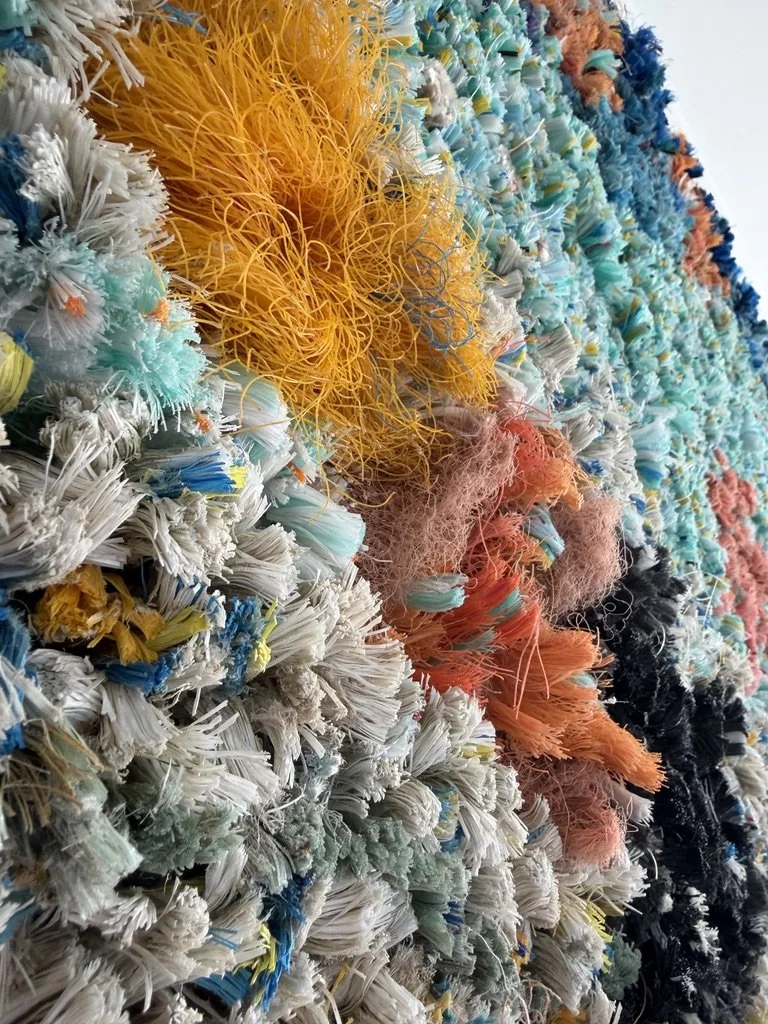
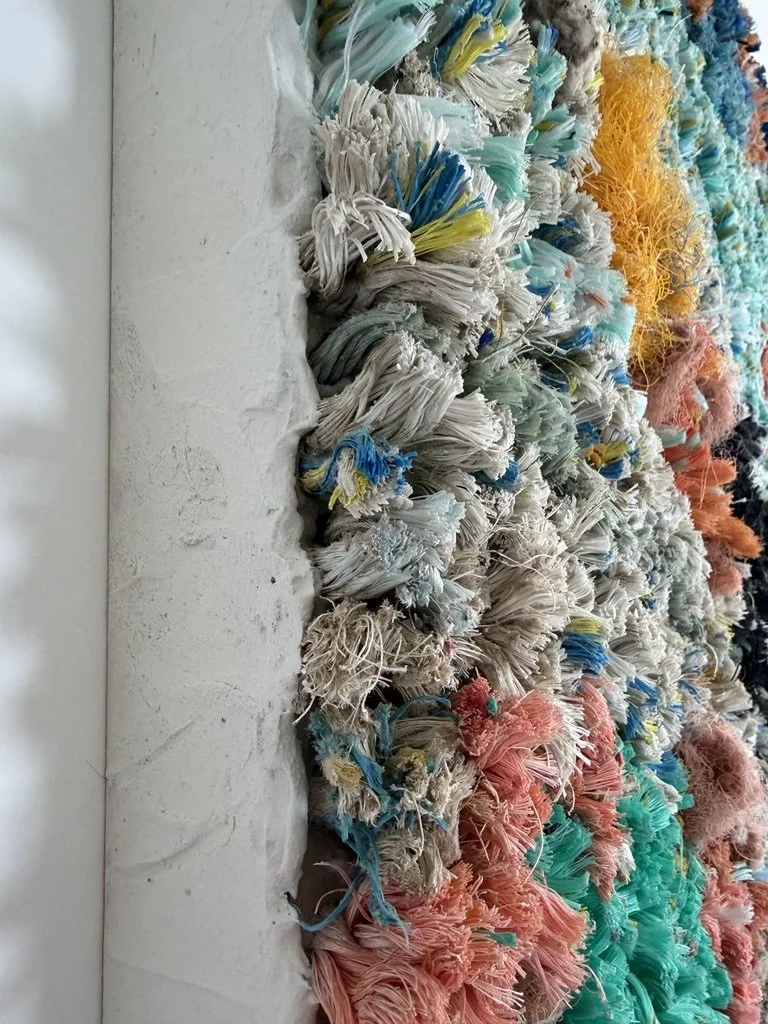
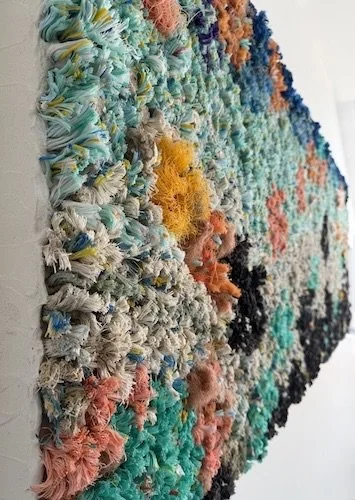
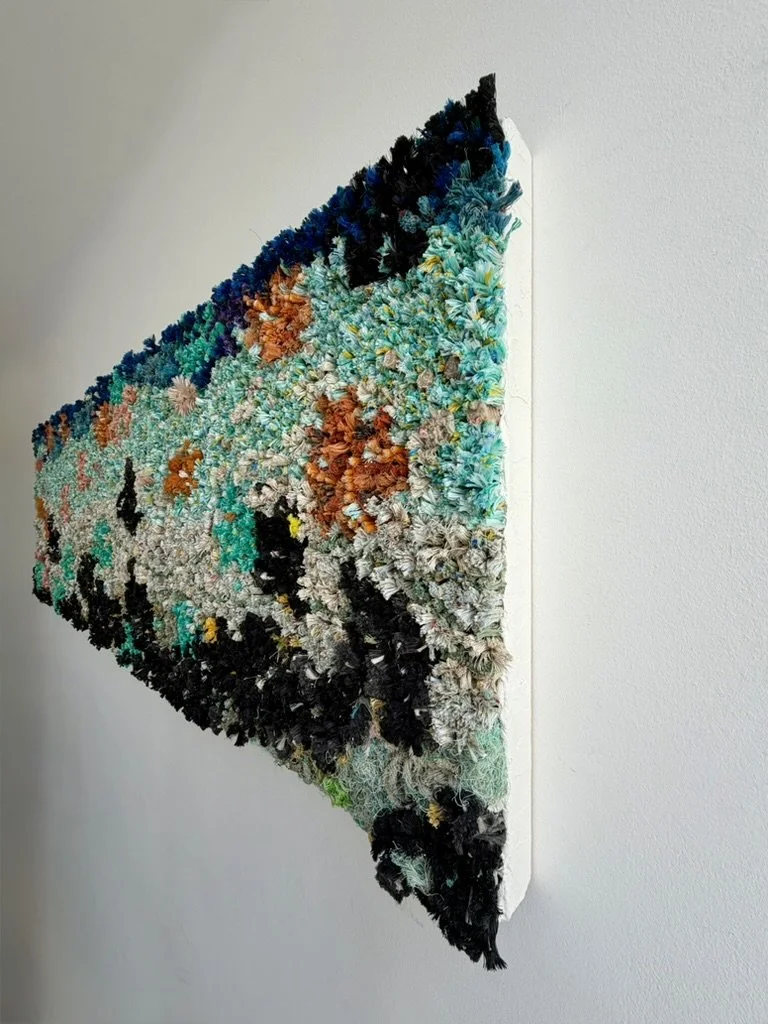
The images are of - The Marevenants, 2026. 100% waste: ghost gear and marine industry waste recovered through Project One Wave missions and network. Tryptich: approx. 230x76x12cm